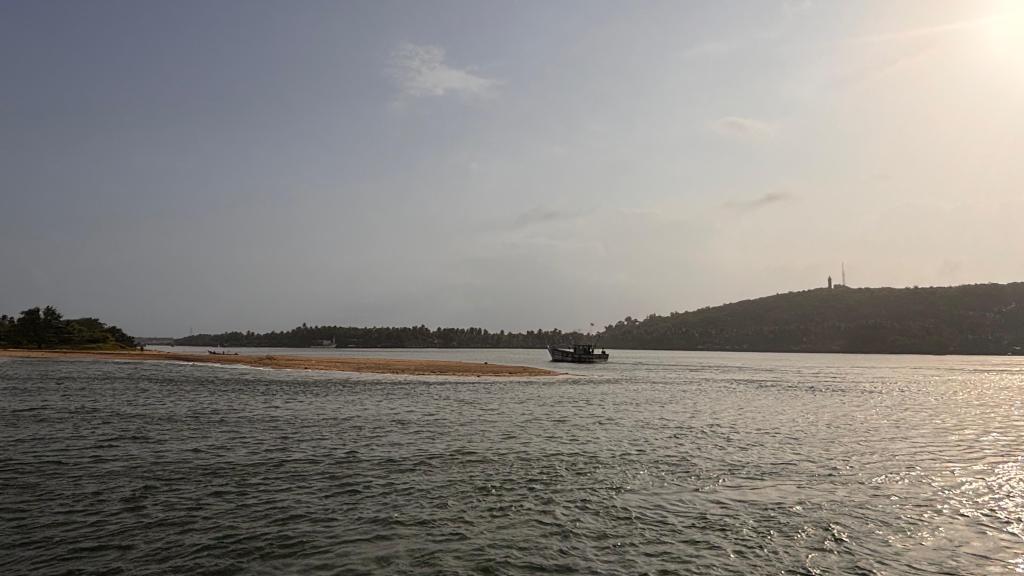
Three Waters takes its name from the point where the Sal and the Betul give up their separate identities and become one thing before the Arabian Sea takes all of it — and by the first evening in South Goa, I understood the name applies to more than a hotel. It describes what the whole place had started to do to my sense of time.
I drove down from Bangalore in the middle of the monsoon, expecting the trip to prove the old excuse right — bad weather, bad roads, slow going — all of which turned out to be true until we drove into Goa. The roads were such a contrast between the two states. The roads in Goa were some of the best I’d driven on all year. Not just the highways either; the narrow interior roads that led to villages I couldn’t have named a week earlier were smooth, well-kept, cared for. It was such a small thing, but it undid an assumption I hadn’t realized I was carrying — that neglect and rain go together, that a place forgives its bad roads by blaming the sky. Someone in Goa had decided otherwise. Karnataka has a lot to learn, and the first thing we’d do well to learn is to not make excuses for what should be basic public infrastructure.
The unhurried care we were introduced to, in Goa, showed up everywhere, once I started looking for it. A man sat by a riverbank with a fishing rod propped in his hand, in no apparent rush for the fish to decide anything. At bus stops, in a stretch of South Goa where public transport is thin on the ground, people waited without the restlessness I’d bring to the same wait in Bangalore. And once we arrived, at a hotel where guests were few that week, the staff moved through their work with a kind of unhurried excellence — not slow because there wasn’t enough to do, but attentive because there was time enough to do it properly.
Shiloh was the person who made that abstraction into someone I could actually name — and fittingly, he was the very first thing that went right on the trip. We arrived on Friday evening, and my wife came down with indigestion almost as soon as we’d settled in. Shiloh, the staff member who ended up looking after us most all week, didn’t send someone for medicine — he went himself, made sure we had it in time, and when he came back, he asked after her and wished her a quick recovery. There was nothing performative in it. He had the same calm, composed manner he’d have doing anything else on the property, on our very first evening as guests he’d barely met.
That first night, once things had settled, the sound outside our room had layers I hadn’t expected. There was the plain part: rain landing on the roof, the road, the balcony floor, the sound any monsoon rain makes anywhere. But underneath it, or maybe just alongside it, there was another sound entirely — the rain meeting the river itself, out where the estuary widens toward the sea. From the balcony you could take in the whole scene at once: the Arabian Sea on one side, a hill rising on the other, and a lighthouse on top of the hill, less like a landmark than like something posted on watch. I don’t think I’d ever thought of rain as a sound with a location before. In Bangalore it just falls; at Three Waters, it fell into something, and you could hear the difference.
Shiloh’s gesture that first evening raised a question my wife and I ended up actually sitting with, rather than just admiring from a distance: could we live at this pace, not just visit it? Our honest answer was measured — we could do more than a weekend of it, maybe a week or two, but not yet build a whole life at Goa’s speed. Except I noticed myself carve out an exception the moment writing entered the sentence. If writing were genuinely my main work rather than something I do around the edges of a faster life, I don’t think I’d mind living here at all. I need to slow down, notice more, think more — and this place seemed built for exactly that, in a way Bangalore, for all its energy, isn’t.
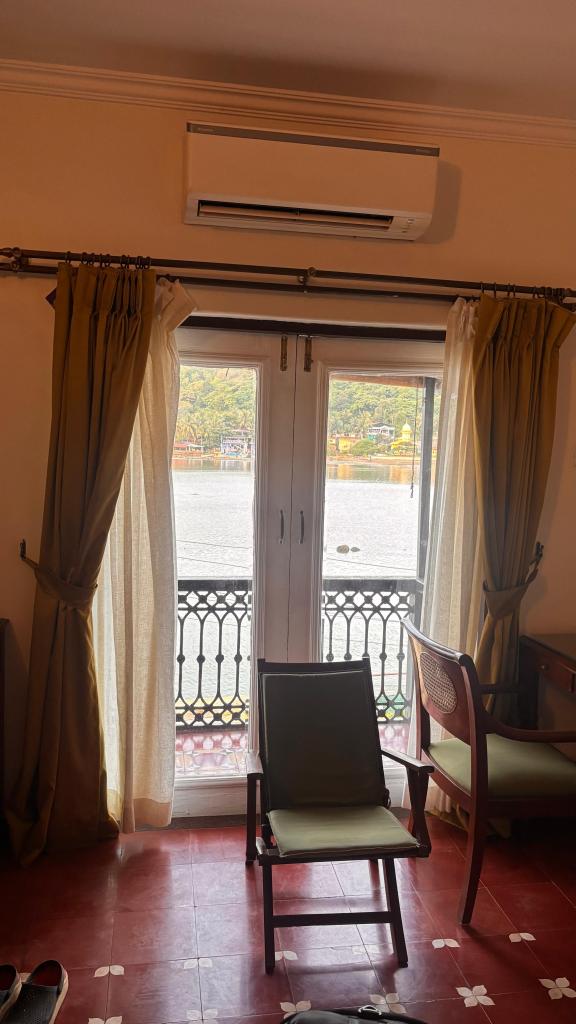
Saturday was our wedding anniversary, and it started the way the whole trip seemed to want to go: a late, unhurried breakfast at Three Waters. The restaurant was small — just four tables inside its walls, two more out on the balcony facing the river — and we took the river-side seats, which felt like the right call for the day. The spread ran both Indian and English, and everything about it, food and service alike, was excellent.
For lunch, the hotel pointed us toward Amarela by the Riverside, a short drive away. We’d decided to keep the day close rather than venture far — no need to rush anywhere, no reason to. It turned out to be a good decision on its own terms: live music playing somewhere under everything, mild and pleasant, and food and drinks that matched it.
The temptation to go for something manufactured rather than the genuine came to us on Saturday evening, when we stepped foot onto Cavelossim beach. A salesman working the beach for a Karma Group property found us there — his property barely a kilometre away — and handed us a scratch card; underneath was an “assured gift”: an iPad, AirPods, a Samsung phone, or a free stay at one of the group’s international properties. The promotion, he told us, would take about an hour. It took three. The property itself was handsome enough, but the pitch, once it started, felt airless. Anson, a young man from Udupi on his first job, was the one assigned to us; when we didn’t move quickly, he brought in his manager, Naresh, who clearly had years of this in him. Between the two of them we got the full treatment — profiles taken, the case made that we needed more holidays than we thought, photograph after photograph of members living it up at properties around the world. Neither my wife nor I felt even slightly pulled, and trying to explain why to two men doing their jobs well turned out to be its own kind of test. We want holidays, we told them, but we don’t live for them. We want new experiences, but ones we’ve gone and researched and chosen ourselves, not ones handed to us pre-curated. We want security, but not the kind that comes from a resort full of people just like us, sealed off from whatever place we’re actually in. By the time we walked out, three hours gone, the beach sunset we’d come for was long past — though the evening had clouded over and turned to rain by then anyway, so it was a smaller loss than it might have been. We left with the gift of a free stay at one of their international properties and all our sense of what we actually want intact, which turned out to be the more useful thing to carry out of that room. I felt for Anson, who’d done nothing wrong except draw the wrong couple that day. And I felt for the room around us, at least thirty other families being worked by thirty other salesmen just as good as ours, because I could tell that saying no does not come as easily to everyone as it apparently did to us.
Sunday morning we set out to find The Bible Church in Panjim, a church I had discovered on the internet. It took us over an hour of driving to reach the church, that met in a hall on top of Hotel Ritz Classic, nothing about the address that would have told us what to expect. They were partway through a series on Romans, and that Sunday’s portion was Romans 5. The pastor, Steve, had a way of taking a dense piece of doctrine and setting it down in front of you as something you could actually use that week — not a small thing to watch someone do well. It was great to be in a church that leaned so deliberately on expository preaching, working through the text itself rather than around it. During the announcements they asked us to introduce ourselves, two strangers clearly not from Panjim, and nobody made it awkward. Pastor Steve closed the service with a prayer, and somewhere in it he prayed for us by name, for our anniversary — a small thing that didn’t feel small at all.
The moment that has stayed with me most, though, was a little girl named Grace. She came up to my wife on her own and handed her a card, hand-drawn, wishing us a happy anniversary — something she’d apparently decided to make for two people she’d never met before that morning. Grace also played the violin and sang, part of a small group who rendered a special song during the service, and she was as cheerful and unguarded doing that as she’d been walking up to a stranger with a card. Near the end, the church prayed over Grace too — she was flying to Chennai the next day for surgery, related to a heart condition. Nothing about how she carried herself gave that away; you would not have guessed it from watching her.
It was hard not to think back to the night before, in that room at the Karma Group property, where two men who didn’t know us worked hard to manufacture a version of warmth aimed at closing a sale. Nobody in the hall above Ritz Classic that Sunday morning had anything to gain from us — we weren’t going to buy a membership or become anyone’s repeat customer. They asked about us anyway, prayed for us anyway, and a little girl with her own surgery ahead of her still found it worth her while to draw us a card. A performance wants something back, even if it’s only your attention held a minute longer. This didn’t ask for anything at all. What struck both of us was how completely the church visit dissolved the usual feeling of being strangers somewhere new — we hadn’t done anything to earn that welcome, we’d just walked in. It’s one thing to believe, in the abstract, that the church is one big family of God’s people, scattered across the world; it’s another to have a little hall above a hotel in Panjim make that true for an hour on a Sunday you’ll remember for years.
After church we made our way to Fontainhas, Panjim’s old Portuguese quarter, not far from Ritz Classic. It reminded both of us of Pondicherry, our hometown, in a way we hadn’t expected — narrow lanes, the same sense of a European hand laid long ago over something else, still visible if you looked for it. The colour that ran through everything was blue, though yellow and white showed up on plenty of walls too, and there wasn’t a building in the quarter that didn’t look like it belonged in a photograph. A few of them had signs asking visitors not to photograph them at all — whether that was about tourists being a nuisance or about protecting the property itself, I couldn’t say, but it was a small, deliberate note in a place that otherwise seemed to invite every camera in sight. We stopped at a cafe in the quarter for a cold coffee, and wandered into a shop called No Nasties, an organic clothing store where we were the only customers the whole time we were there. In there, we picked up a solid perfume and a sunscreen from a brand called The Bare Bar — good products, and not the kind of prices you’d brace for in a quarter that photogenic.
From Fontainhas we went on to Koknii, a small local mess-style canteen in Panjim, for a Goan thali. It was a Sunday, the place was overflowing, and the wait for a table ran to about half an hour — worth every minute, it turned out, once the fish curry arrived, a taste that showed up again and again across different restaurants on the trip but never stopped feeling specifically like Goa. What struck me at Koknii wasn’t just the food, though. It was how they handled the crowd: you were handed a token and asked your party size the moment you walked in, and that number told you almost exactly how long you had. Ours was 24; they were calling 10 when we arrived, so we knew roughly what we were in for and had come prepared, arriving before the hunger pangs set in. While we waited, I studied the photographs on the wall — Rajdeep Sardesai, the actress Sameera Reddy, the cricketer Dhawal Kulkarni, and others, a small gallery of people who’d apparently found their way to this same crowded room. When our number was finally called, we were shown to a two-seater tucked into a cozy corner, and the service that followed was as precise as the token system that got us there. It was, without qualification, a perfect outing.
That Sunday evening, after a little shopping around Porvorim, I found a different version of the same idea at Baker’s Street, a bakery there that, by local word of mouth, is where people actually go for their daily bread. I went in braced for something like the neighbourhood bakeries I know from Bangalore — a glass case, a bit of make-do, nothing to look at twice. Instead the place looked, frankly, premium: clean, considered, the kind of look I hadn’t expected from a shop whose real business was daily loaves. And yet it clearly was that shop — people came in and out for their bread, and a steady handoff of pre-ordered birthday cakes was happening at the counter the whole time we were there, boxed and ready for people who weren’t tourists. We had dinner there — a beef burger and a dark chocolate pastry, both delicious without qualification. The staff behind the counter were efficient in a way that felt less like speed and more like knowledge — they seemed to actually understand what they were selling, not just hand it over.
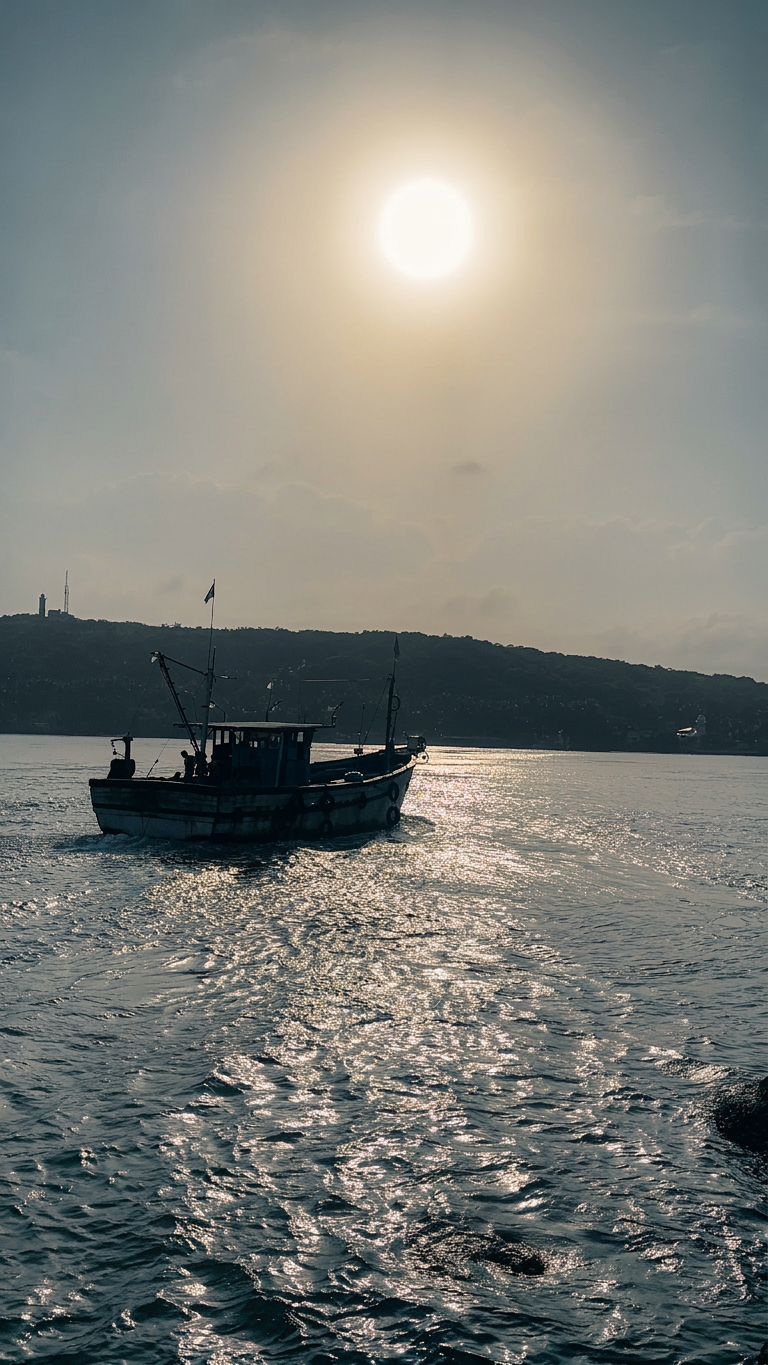
Monday morning, our last at Three Waters, I set out for a walk along the River Betul. I’d meant to reach Betul Fort, four hundred metres from the hotel, but the fort itself turned out to be little more than a ruin, so I kept walking along the water instead, until a canal — three or four feet wide, freshly dug to drain the hill runoff into the river — stopped me and turned me back. Along the way I passed fishermen cleaning their nets, clearly finished with a job they’d started well before dawn; it occurred to me that my idea of an early morning was, by their clock, already the middle of the day. Further on, the same man I’d seen the day before was back at the riverside with his rod, a bag beside him that looked like it already held something. And by a small temple along the water, a man sat quietly; on my way back, I passed him again, now moving alone through some kind of exercise, unwatched and unhurried, as if the whole point of doing it there was that no one needed to see it to make it worth doing.
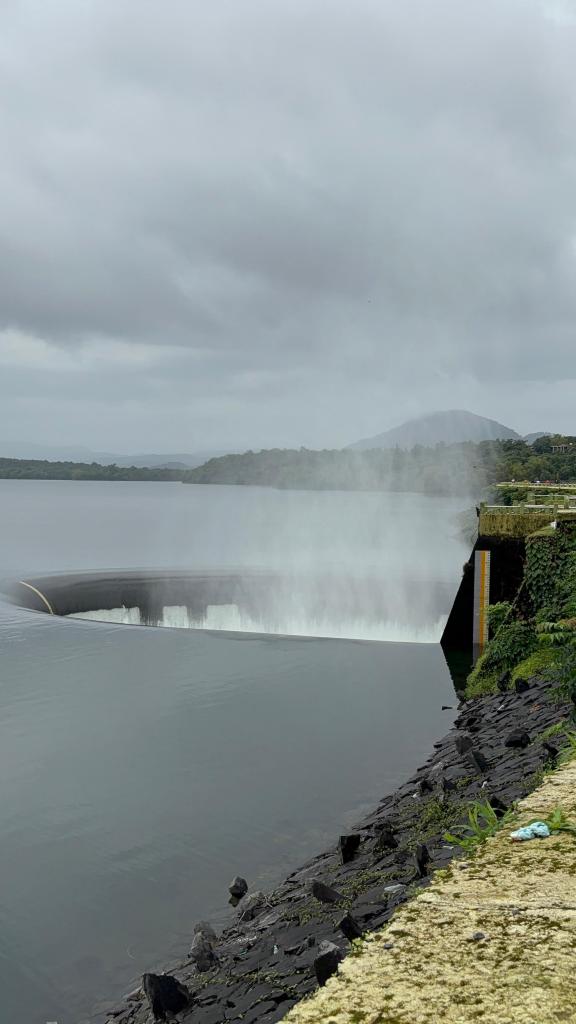
After breakfast we checked out of Three Waters and drove to Salaulim Dam, a couple of hours further than we strictly needed to go that day, and worth every extra minute of it. I’d seen videos of the dam before the trip and specifically wanted to see it in person, for one reason: it’s a Duckbill Spillway dam, one of only a handful in the world, built so that the water spilling over it forms something close to a whirlpool. No video had prepared me for the real thing. The reservoir itself was still and serene, and then the spillway broke that quiet completely — the sound of the water speeding down, the mist it threw up into the air, both things a screen simply cannot carry across. We stood at the viewpoint under a low, drizzling sky and just took it in. I’d been curious whether the name had any real connection to the River Sal at Three Waters, but it turns out it doesn’t — a coincidence of naming, nothing more, though it felt fitting all the same that a trip built around water kept finding new water to be amazed by.
It was on the way back from Salaulim that Shiloh reappeared. We’d left a flask and a water bottle behind at checkout without noticing, and when I called to ask, he didn’t just tell us where to collect them later — he drove out himself to the Betul junction to hand them to us as we passed, the same man who’d gone out for medicine the evening we arrived, closing the trip the same way he’d opened it.
Our next stop was Palolem, likely the biggest beach town on the road heading south out of Goa toward Karnataka. We’d been pointed toward The Mill for lunch — it kept turning up on Instagram and YouTube, the kind of place that gets recommended everywhere — but once we were actually there it was clear it wasn’t built for a couple who’d just checked out that morning with a long drive still ahead. The Mill is a place you go when you have an afternoon to spend, not a pit stop, so we adjusted and picked up dessert instead: a carrot and chocolate cake we ended up eating in the car later, after lunch, good enough to sit right alongside the one we get from Magnolia Bakery back in Bangalore. Lunch itself we found at an ordinary local dhaba nearby, nothing built for Instagram about it, and the Goan thali there didn’t disappoint — the same fish curry that had shown up at Koknii and everywhere else on the trip, tasting exactly like itself no matter which unremarkable kitchen it came out of, which by that point in the trip had started to feel like its own small mystery worth sitting with.
Then the long drive back to Bangalore, broken by dinner in Davangere, and home by around two in the morning — the trip folding itself, the way most good trips do, into one last stretch of road.
Looking back across the whole of it — the roads, Shiloh both coming and going, the church above Ritz Classic, Koknii, Baker’s Street, Fontainhas, Salaulim, Palolem — I keep circling the same distinction. Bangalore, and the working life I carry there, rewards productivity: more output, more efficiency, more of everything done faster. South Goa, as far as I could tell, wasn’t doing very much by that measure. But whatever it did do, it did completely, without half-measures. It isn’t that output stops mattering; it’s that a different thing gets rewarded — not how much, but how well, and what that does to the person doing it. For a while I didn’t have the exact word for it. “Unhurried” gets the surface right, but it misses the contentment sitting underneath the slowness — the sense that a smaller life, done properly, might not be smaller at all.
The Karma Group evening sharpened the question rather than answering it outright, but by the end of the trip I think I had landed somewhere. Whatever this thing is, it isn’t passive — it’s a contentment that can look a determined, well-rehearsed pitch in the eye and still say no, because it already knows what it wants and didn’t get that from anyone’s marketing. Your own sense of what makes a life worth living shouldn’t be swayed by what the world at large has decided contentment ought to look like; the moment you let someone else barge in and plant their version of it, even with the best production values in the business, is the moment you’re at risk of losing something you can’t easily get back. A firm, shared conviction — held quietly, between two people, without needing anyone else’s approval — turned out to be its own kind of blessing in a place that otherwise makes its living selling people a version of paradise. And then, the very next morning, a room full of strangers with nothing to sell us showed what the same warmth looks like when nobody’s asking for anything back.
What this trip adds up to, in the end, is not complicated: the pace of a place is not just weather or geography, it is a series of small decisions — to fix a road anyway, to go yourself for medicine instead of sending someone, to drive out to a junction to return a forgotten flask, to number a queue instead of letting it turn to chaos, to keep a bakery run with real craft instead of just getting by, to exercise where no one’s watching, to pray for two strangers and mean it, to say no to a beautifully made pitch for a life that isn’t actually yours. Every one of those decisions could have gone the easier way, and nobody passing through would have been any the wiser. Someone chose otherwise anyway, again and again, all week. Three Waters, it turns out, is a good name for more than a hotel — it’s what happens when a place keeps choosing, the way the Sal and the Betul do, to become one steady thing before it ever reaches the sea.
/html


Leave a comment